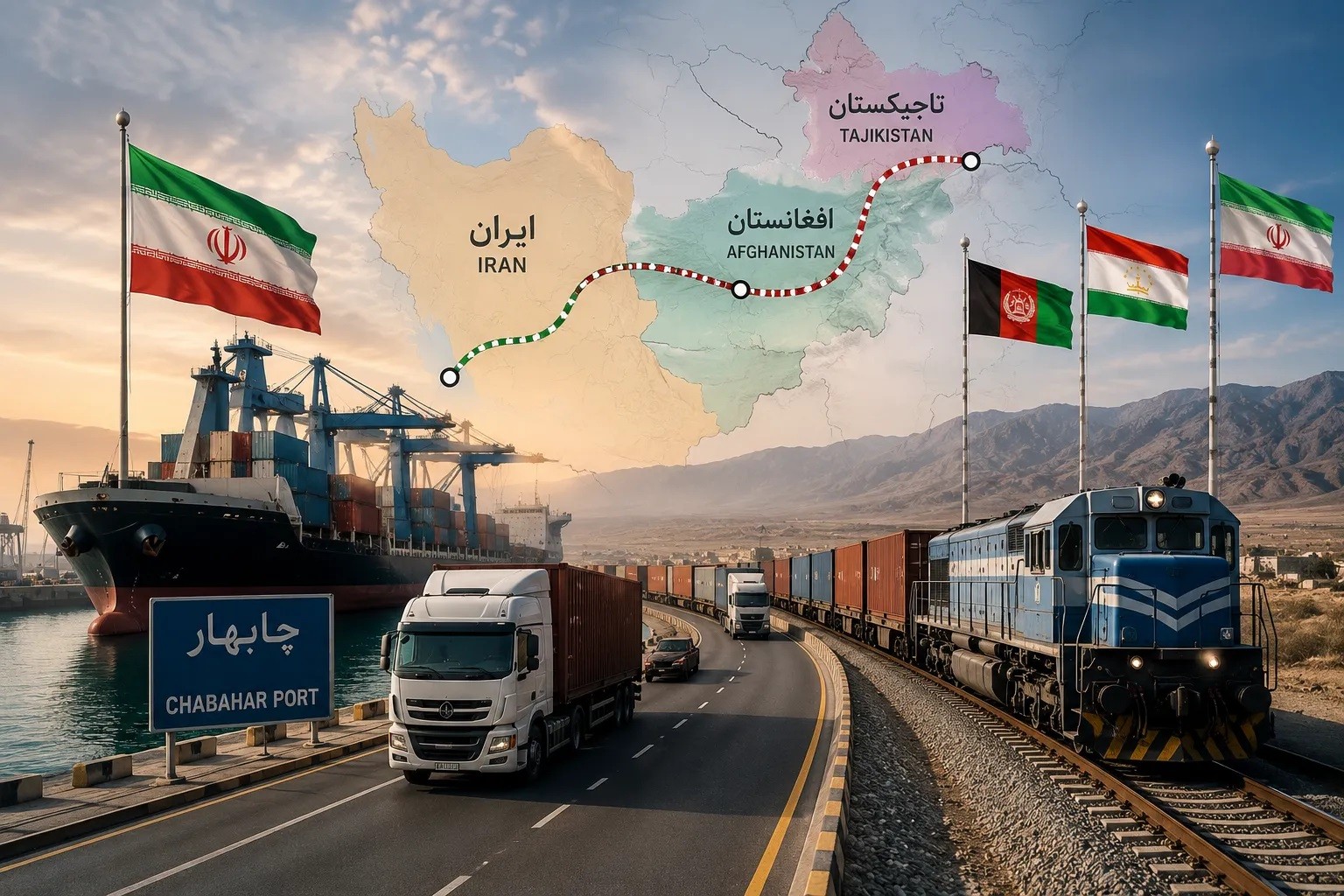
o the outside world, thereby reducing its economic isolation and enhancing its regional standing. The joint India-Iran project also serves as a model for regional cooperation, bringing together the interests of several countries and promoting economic integration in the region, thus contributing to stability and development in Afghanistan and the wider region.
In light of this, the connection of the aforementioned two countries to Chabahar Port represents a strategic shift in regional dynamics. This port reduces Afghanistan's dependence on Pakistan and opens up new avenues for economic cooperation between Afghanistan and India. This development could lead to fundamental changes in the region's political dynamics, assuming that Afghanistan is able to make more independent decisions that could influence the regional balance of power. Therefore, the rail and road connectivity of Tajikistan and Afghanistan to Iran, and ultimately to Chabahar Port, could break their isolation and unlock significant markets for them.
Revival of the Five Nations Corridor
From another perspective, the transit agreement between Iran, Tajikistan, and Afghanistan can be viewed as a preliminary step and a foundation for the development of other major corridors in the Eurasian region, the most significant of which is the construction of the Five Nations Railway Corridor (FNRC). The initial agreement for the development of the FNRC project was signed in December 2014 in Dushanbe, the capital of Tajikistan, but has since experienced a sluggish trajectory. With a total length of 2,100 kilometers, this project will traverse five countries—China, Tajikistan, Kyrgyzstan, Afghanistan, and Iran—and will connect China to the Iranian ports of Chabahar and Bandar Abbas. Approximately 50% of the entire railway, roughly 1,148 kilometers, will pass through the Afghan provinces of Kunduz, Balkh, Jawzjan, Faryab, Badghis, and Herat. Based on initial estimates, the projected value of this project exceeds $2 billion, with the Afghan section to be financed by the Asian Development Bank (ADB).
Under the initial agreement, this railway was to be constructed within five years, that is, by the end of 2019; however, it has not yet been realized for various reasons. Many economic experts have hailed the FNRC project as a milestone for further strengthening economic cooperation in the region. This project will not only increase the transport capacity of the involved countries but will also bolster their national economic growth, expand trade exchanges, and enhance tourism relations. Moreover, it will reduce the commercial transport distance between the East—from China to Iran—and the West toward Europe, and will assist member states in accessing the open waters of the Persian Gulf through Iran. Additionally, freight costs along this route are expected to decrease due to the reduction in distance and transit time.
This project, particularly for Afghanistan, can yield substantial economic benefits by improving its access to Iran's Chabahar and Bandar Abbas ports, thereby providing abundant opportunities for trade expansion. Furthermore, it can increase regional trade and contribute to job creation alongside greater trade volumes. In addition, the FNRC will connect Central Asian countries to Europe via Turkey and Iran. Thus, positioned at the heart of this vital Eurasian rail corridor, Afghanistan stands to benefit significantly from considerable economic advantages.
For China and the Central Asian countries, the FNRC will substantially reduce transit costs and time. It will help Tajikistan reduce its political dependence on Uzbekistan and Russia. It will also allow Kyrgyzstan to diversify its export routes by bypassing Uzbekistan. Overall, this railway will lower the cost of rail access for Central Asian countries to the Persian Gulf and India, bringing Iran's Chabahar Port back into the spotlight.
The rail and road connectivity among the three Persian-speaking nations of Iran, Tajikistan, and Afghanistan can yield positive outcomes for all three countries and, ultimatel