
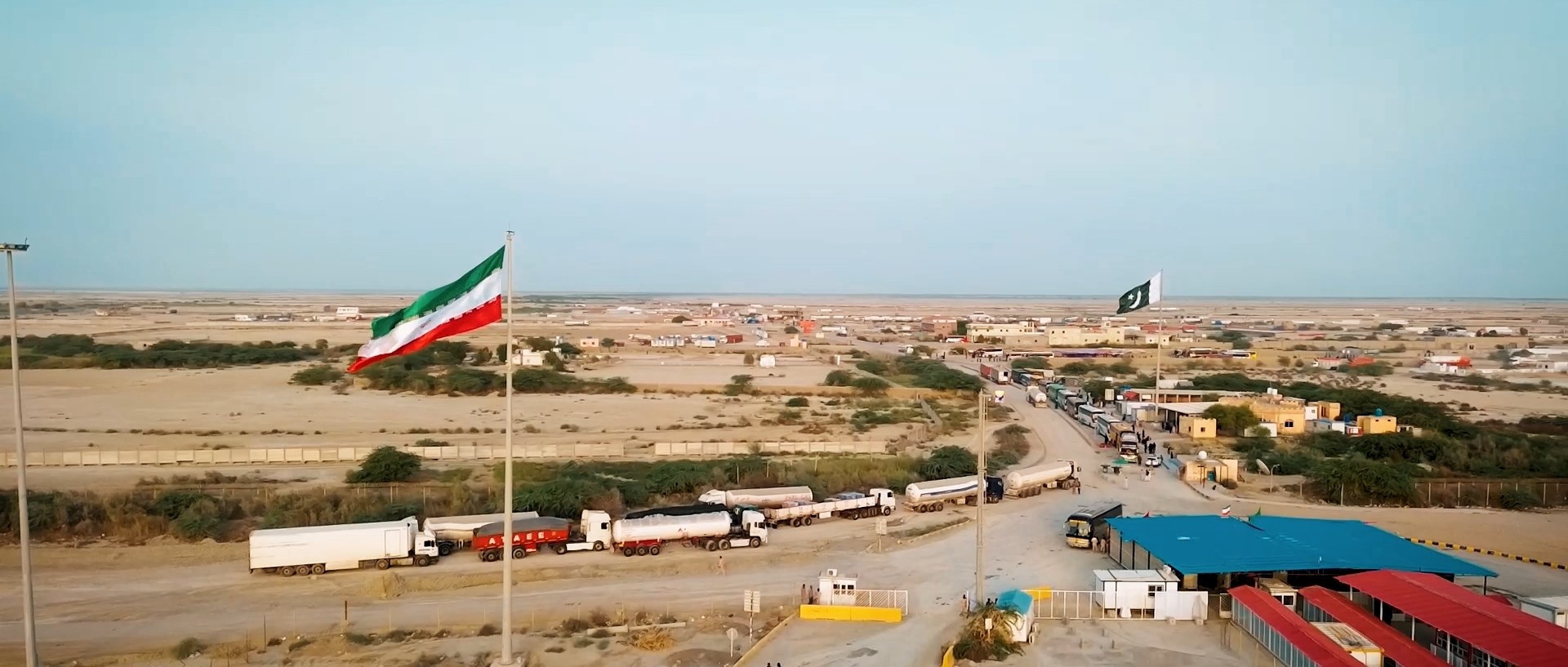
Hossein Forouzan, Secretary of the High Council of Free and Special Economic Zones, said during a visit to the Rimdan Detached Zone of the Chabahar Free Zone: «“Rimdan is one of the country’s important border crossings and, with the development of infrastructure, export and import terminals, and transportation services, it can become one of the country’s important and efficient commercial border crossings.”»
Rimdan is no longer merely a border crossing point. The movement of 3,969 trucks carrying 87,318 tons of transit cargo points to an emerging capacity that could connect Pakistan with Afghanistan and Central Asia and, alongside Chabahar and Gwadar, develop into a complementary link within the regional trade network.
Official statistics recorded from 12 Esfand 1404, coinciding with the formal launch of the Rimdan Detached Zone of the Chabahar Free Zone and the allocation of an independent customs code to the area by the Islamic Republic of Iran Customs Administration, through 30 Shahrivar 1405 show that 3,969 trucks carrying 87,318 tons of goods in transit from Pakistan to third countries passed through Rimdan.
Of this total, 3,532 trucks carrying 77,713 tons of cargo were bound for Afghanistan, while 437 trucks carrying 8,605 tons were bound for Uzbekistan.
These figures, recorded during the initial months of Rimdan’s formal operation under an independent customs code, may indicate the border’s potential to play a role beyond bilateral trade between Iran and Pakistan. The movement of Afghan-plated trucks carrying transit cargo may also indicate the emergence of cross-border transportation links along this route.
However, the movement of cargo through a border crossing alone does not constitute a sustainable transit corridor. The continuity of such flows depends on road quality, terminal capacity, truck services, dwell time, customs procedures, warehousing facilities and the predictability of border-crossing processes. In this regard, Forouzan’s emphasis on developing infrastructure, import and export terminals and transportation services directly relates to the requirements for consolidating and expanding these flows.
Rimdan–Gabd: A Complementary Capacity on the Iran–Pakistan Border
Alongside the existing capacity, the proposed Rimdan–Gabd Joint Free Zone between Iran and Pakistan could, if realized, provide a complementary platform for expanding trade, logistics services and economic activity on both sides of the border.
The project is being pursued within the framework of Iran–Pakistan cooperation, and its realization requires the completion of legal, technical, executive and infrastructure-related processes. If these requirements are met, the joint zone could strengthen capacities such as warehousing, cargo processing and consolidation, as well as facilitate cross-border trade flows.
Chabahar and Gwadar: Sister Ports and Complementary Partners, Not Rivals
Rimdan’s proximity to Gabd and its geographical connection to Gwadar create an opportunity to consider a broader link among Gwadar, Rimdan and Chabahar—one that could, within the framework of regional cooperation, contribute to strengthening trade and transportation flows between Iran and Pakistan.
From this perspective, Chabahar and Gwadar can function as sister ports and complementary partners rather than rivals. Such an approach emphasizes synergy, the use of different port capacities and the development of an integrated network along the Makoran coast rather than competition between ports.
Within this framework, cooperation between the Chabahar Free Zone Organization and the Gwadar Port Authority of Pakistan in port operations, trade, transit and logistics could help strengthen this connection. The memorandum of understanding between the two sides has also provided a basis for expanding cooperation in these areas. However, turning this potential into a sustainable commercial flow still requires infrastructure development, customs coordination and effective operational mechanisms.
From this perspective, if infrastructure is developed and Iran–Pakistan cooperation continues, Rimdan could serve as a land-based link between the transportation and trade networks on both sides of the Makoran coast. Along this route, Gwadar and Chabahar could form part of a complementary regional network rather than being placed in direct competition with one another.
Infrastructure: The Condition for Turning a Border into a Corridor
In regional trade and transit, the importance of a border crossing is not measured solely by the number of trucks passing through it. For cargo owners and transportation companies, time, cost and the predictability of border-crossing procedures are decisive factors.
Reducing dwell time, accelerating customs procedures, providing adequate parking and truck services, improving access routes, expanding warehouses and cold-storage facilities, and strengthening operational coordination among agencies stationed at the border are among the requirements for turning existing capacity into a sustainable flow.
These requirements form the link between Rimdan’s potential and its transformation into a reliable transit corridor. This is also reflected in Forouzan’s emphasis on developing infrastructure and transportation services.
Rimdan: From Border Crossing to a Regional Transit Link
The statistics recorded from 12 Esfand 1404 to 30 Shahrivar 1405, together with the pursuit of the Rimdan–Gabd Joint Free Zone and the cooperation potential between the Chabahar Free Zone Organization and the Gwadar Port Authority of Pakistan, point to a range of capacities that can be further developed. Turning these capacities into a sustainable transit network, however, requires infrastructure development and effective operational coordination.
Rimdan’s future role cannot be defined solely by the number of projects or trucks passing through the border. Establishing a continuous flow of cargo, reducing transit time and costs, and increasing route predictability for economic operators are among the key factors in consolidating its position within the regional trade network.
Against this backdrop, Hossein Forouzan, Secretary of the High Council of Free and Special Economic Zones, has emphasized that Rimdan is one of the country’s important border crossings. His emphasis once again highlights the importance of addressing the border, infrastructure and surrounding transportation network as an interconnected system.
With continued infrastructure development and cooperation, Rimdan can be further integrated with Chabahar, Gwadar, Pakistan, Afghanistan and Central Asia, creating additional capacity for regional trade and transit.


